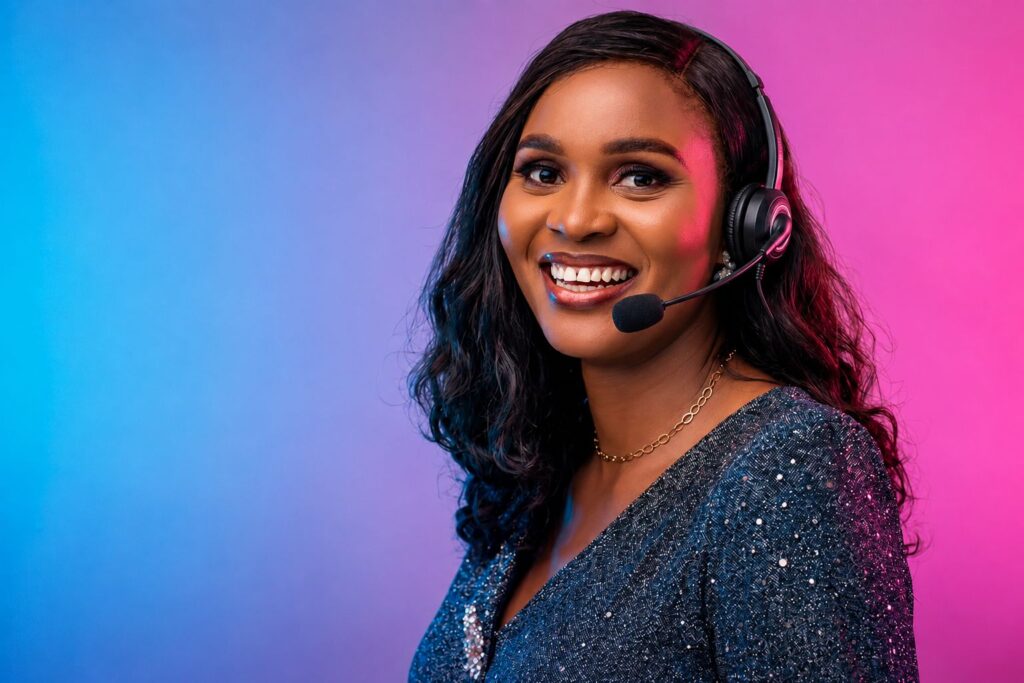

If you have ever watched Chinenye Priscilla Anaemena host an event, you quickly realise that she is not the kind of person who simply walks onto a stage and starts talking. She pays attention. To the room. To the people in it. To what the organisation is trying to say. To the little details that most people might miss. And then she speaks.
There is confidence in the way she does it, but there is also something else underneath the confidence: preparation. That, perhaps, is one of the easiest things to miss about Chinenye.
People see MC Priscyvibes. They see the woman with the microphone, the voice, the energy and the ability to hold a room. They see the awards. They see the corporate events. They see the television appearances.
But before all of that, there was a young woman learning the discipline of communication.
Her professional journey stretches back more than a decade and cuts across journalism, broadcasting, public relations, education, public speaking and corporate communication.
One of the earliest documented chapters takes us to Nasarawa State in 2007, where she worked as a peer educator with the United Nations Population Fund on community sensitisation.
It is an interesting place to begin the story of someone who would eventually become a professional communicator. There was no glamorous stage. No corporate audience. No carefully produced event. Just people, information and the challenge of making one meaningful enough to reach the other.
Years later, that same instinct would show up in very different places, in newsrooms, on radio, in training rooms, at corporate events, on television and eventually on some of the biggest stages she now occupies as MC Priscyvibes.
Chinenye’s background in journalism and broadcasting gave her an education that no certificate alone could provide. She learned how to listen, how to ask questions, how to read an audience, how to make information interesting and how to tell a story without losing the point.
She contributed to Leadership Newspapers, anchored “Taste of Nigeria” on African Independent Television and “Touching Lives” on 104.5 Crowther Love Fm before her career expanded into the wider world of communication.
Those early media years matter. Journalism put her close to stories and the people behind them. It required her to listen before speaking, to ask questions that could open up a conversation, and to understand that the way a story is framed can influence how it is received. Radio brought another kind of discipline. There was no visual performance to rely on; the voice had to carry the connection. You had to know how to hold attention, create a picture with words and make people feel present even when they could not see you.
Those experiences became part of the communicator she would later become.
They also gave her something that would become increasingly valuable as her career grew: the ability to move between worlds. A newsroom. A radio studio. A boardroom. A classroom. A stage.
The environment could change, but the fundamental work remained the same, understanding people and finding the right way to communicate with them.
And that expansion is one of the things I find most interesting about her. She didn’t abandon one thing for another. She kept building on it.
Journalism became part of her understanding of people. Broadcasting became part of her understanding of audiences. Public speaking became a craft. Professional compering became another expression of that craft. Corporate communication gave her a strategic lens. And teaching gave her a reason to pass the knowledge on.
The transition to professional compering was not simply a move from behind the scenes to the centre of the room. It brought together almost everything she had already been learning.
The journalist’s instinct to understand the story.
The broadcaster’s instinct to hold attention.
The speaker’s ability to connect.
And the communicator’s awareness that every audience is different.
As MC Priscyvibes, those skills became visible.
She learned to walk into rooms where she might not know everyone, quickly understand the atmosphere, work with the programme, connect the different people on the agenda and still make the event feel coherent. But the work does not begin when she picks up the microphone. Much of it happens before the audience ever sees her.
She researches the organisation. She learns its history and milestones. She pays attention to what the event represents. She understands that for many organisations, an event is not just an event, it is another opportunity to tell their story.
That understanding gradually pushed her beyond the traditional idea of what an MC does.
The microphone became a communication platform.
The event became a storytelling opportunity.
The stage became another place where strategy, personality and purpose could meet.
And from there, her work naturally expanded into corporate communication, public relations, training and coaching.
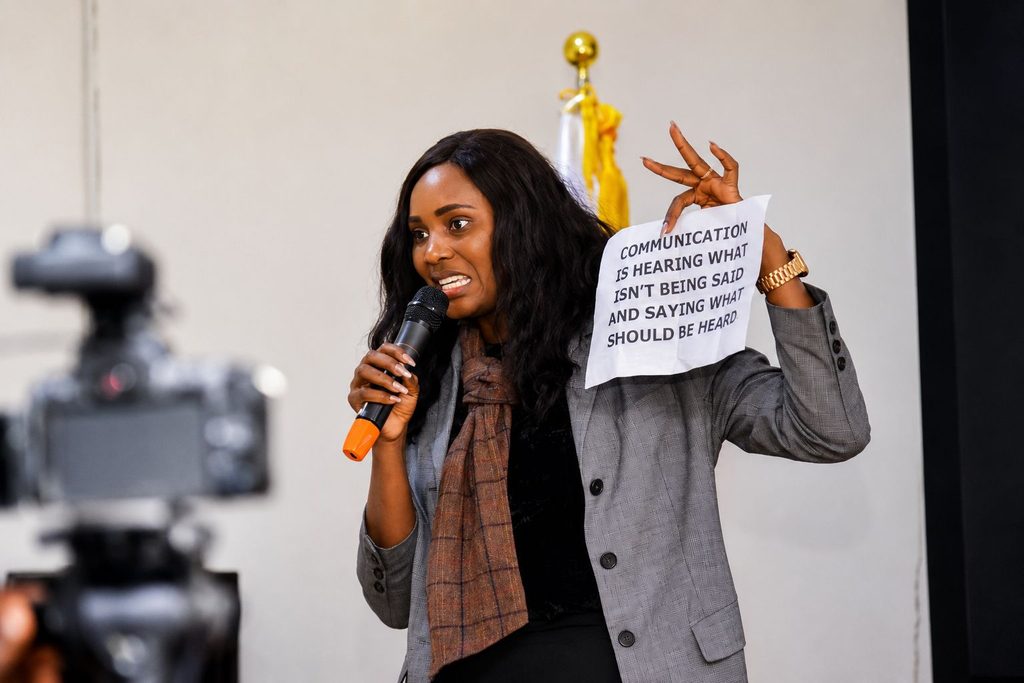
Today, she has worked with institutions including the Standards Organisation of Nigeria, Nigeria Deposit Insurance Corporation, National Judicial Council, Federal Housing Authority and ECOWAS. She has appeared on NTA, AIT, National Assembly Democracy Radio, EFCC Radio, Municipal FM, Radio Maria and Armed Forces Radio.
She has facilitated professional trainings, moderated important conversations and coached individuals, including high-level professionals and dignitaries, on communication. She holds a Master’s degree in Mass Communication and has continued to add professional training in effective communication and digital education.
There is a lot to admire in that résumé.
But a résumé cannot tell you why someone keeps doing what they do. For that, you have to look at what they choose to build.
And one of the clearest clues is The Young Communicators Initiative.
Chinenye founded the organisation and serves as its Board Chairperson, creating opportunities for young people to develop their communication and leadership abilities.
That is significant to me because there is a difference between becoming good at something and deciding that your experience should become useful to other people.
Chinenye seems to have crossed that line.
She is not only interested in becoming a better communicator. She is interested in what happens when another young person learns to communicate with confidence.
That is why initiatives like the Vision 2035 AI-Athon matter. In 2025, the initiative brought young girls into conversations around leadership, public speaking and digital skills, while challenging them to think about solutions to problems in their communities.
The microphone, in other words, has become bigger than the stage. It has become a way of creating access.
And maybe that is the part of Chinenye’s story that is easiest to miss when we focus too heavily on her achievements.
She has been recognised as a leading female MC in Abuja. She has received recognition through Toastmasters International and for her work in professional compering, corporate engagement and leadership. She has also been recognised within the wider communications space, including being ranked among LinkedIn’s leading contributors in corporate communication and serving as a presenter around reputation perception research.
But recognition is the visible part.
The less visible part is the years spent becoming the person who can walk into a room and hold it, the practice, the preparation, the learning, the reinvention, the courage to keep expanding beyond what people already know you for.
Because there is always a temptation, once you become known for something, to stay there.
Chinenye could have simply become “the MC.”
Instead, she became a communication strategist. A trainer. A coach. An educator. A mentor. A founder. A woman creating space for other voices.
And that tells me something about ambition.
Sometimes ambition is not about wanting a bigger stage. Sometimes it is about discovering that the stage you have already been given can be used for something bigger.
That seems to be where Chinenye is now.
She has spent years learning how to speak to people. Now she is increasingly interested in helping people speak for themselves.
And there is something beautiful about that progression.
The microphone that once helped her build a career is now helping her create opportunities. The communication skills she spent years developing are now becoming something she can teach. The rooms she has learned to navigate are becoming rooms she can help other people enter.
And perhaps that is why her work with young communicators feels so connected to everything that came before it.
There is a particular kind of confidence that comes from knowing you have something worth saying. But there is another kind that comes from realising you have the ability to help someone else say what they could not previously articulate.
The first builds you. The second extends you.
That is a different definition of impact.
It is not simply being the person everyone remembers after an event. It is being the person who makes someone else believe that they, too, have something worth saying.
And perhaps that is what I find most compelling about Chinenye Priscilla Anaemena.
She has built a career around a voice.
But she is slowly building something much bigger around the voices of other people.
That is when communication stops being just a profession.
It becomes service.