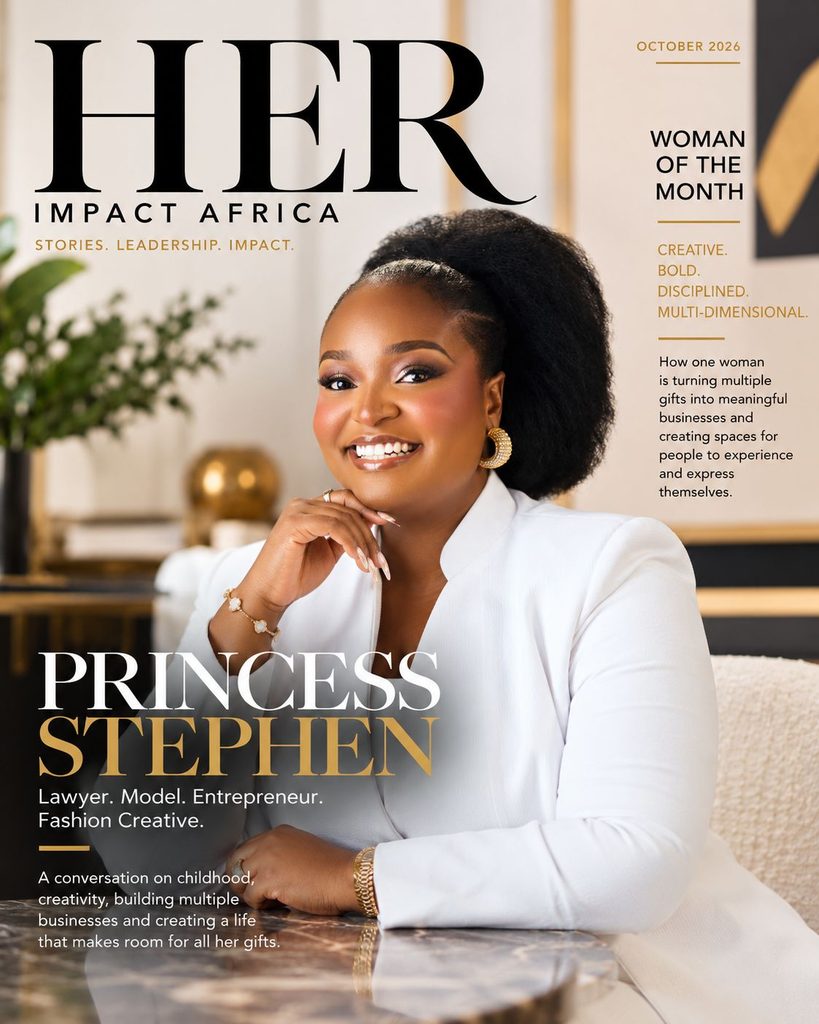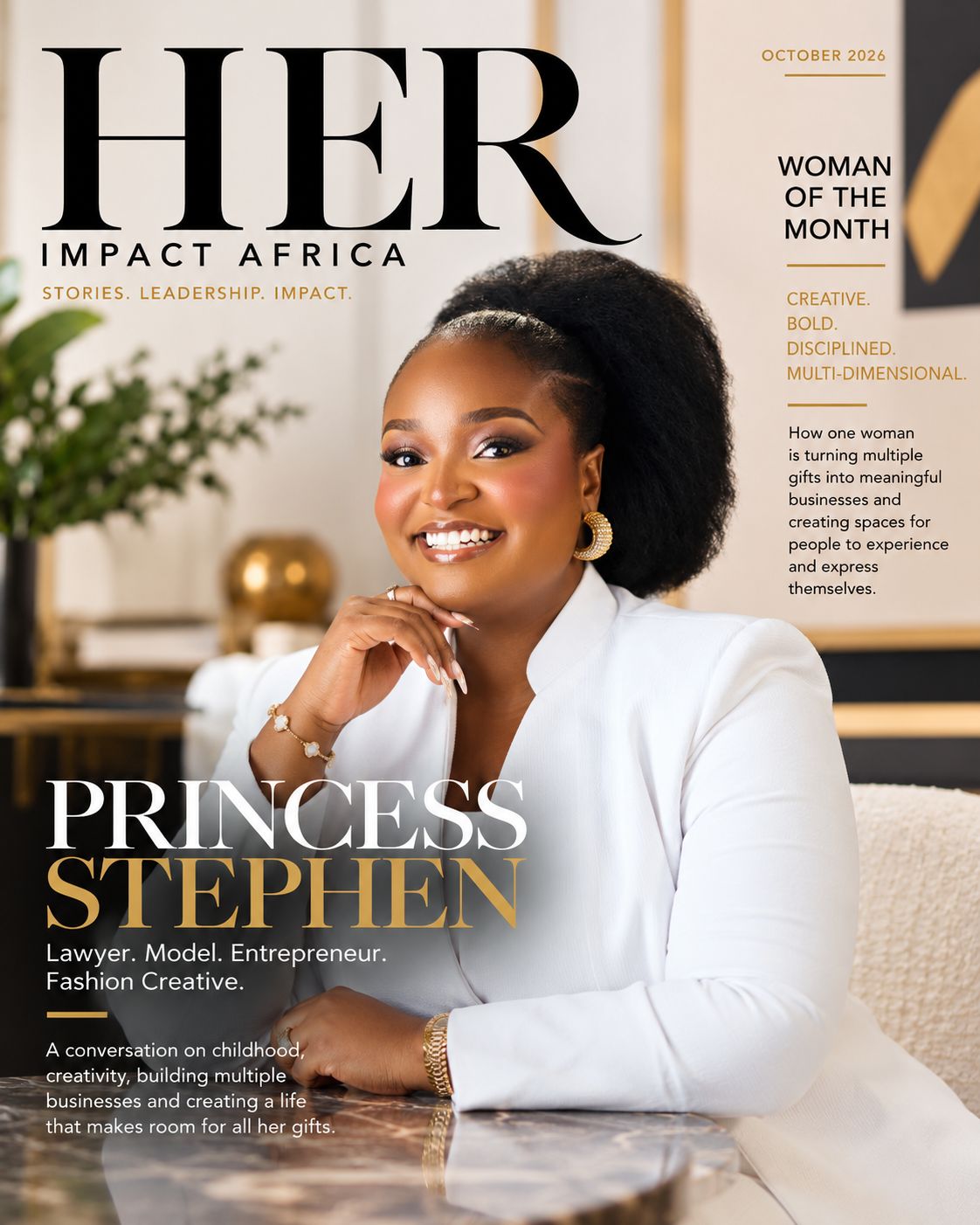

For some people, a career follows a straight line. They discover what they are good at, choose a profession and spend years getting better at that one thing.
Unyime Stephen Ifon, popularly known as Princess Stephen is taking a different route.
A lawyer, model, entrepreneur and emerging fashion creative, Princess is currently in what she describes as her “building season.” She is growing Stephen’s Drinks & More, stepping into fashion with her developing brand We Are Stephen, and building her UGC brand.
But perhaps the most interesting thing about Princess is not simply the number of things she does. It is the thinking behind them.
Her interest in fashion can be traced back to childhood, when she would make clothes for her Barbie dolls with her mother’s needle and thread. Her entrepreneurial journey began with a love for making drinks that eventually became a business. Modelling gave her an avenue to explore identity and representation, while law gave her structure.
Across these seemingly different pursuits is a woman deeply interested in creating, learning and discovering what she is capable of.
Princess describes herself as “a rose with many layers”—someone who is still becoming and intentionally enjoying every layer of the process.
Growing up, she was surrounded by creativity and resourcefulness. Her grandmother was a seamstress, her mother intentionally exposed her to different skills, and her siblings introduced her to music and literature. Even growing up in the barracks, surrounded by children, personalities and talents, became a rich environment for a curious child.
Today, that curiosity has followed her into adulthood.
In this interview with HER IMPACT AFRICA (HIA), Princess talks about her childhood, entrepreneurship, fashion, modelling, learning, faith and what it means to build a life that makes room for all the gifts she believes she has been given.
HIA: For someone meeting you for the very first time, how would you describe yourself? Who is Princess Stephen, and what are the things you are currently building or working on?
PIS: I would describe myself as a rose with many layers. There’s always something new to discover about me, and I think that’s one of the most beautiful things about who I am. I’m really falling in love with the process of discovering myself—understanding who I am, what I’m capable of, and the kind of woman I want to become.
I’m someone who looks beyond the horizon. I’m drawn to the finer things in life—beauty, creativity, meaningful experiences, and the possibilities that exist beyond what I can already see.
And right now, I’m very much in my building season. I’m building a drinks business, I’m stepping into fashion and building a fashion business, and I’m also building my UGC brand. So, I’d say I’m a woman who is still becoming, but she’s becoming very intentionally. And honestly, I’m enjoying every layer of the journey.
HIA: Take us back to your childhood. What was Princess like growing up, and what were the things you were naturally curious about or drawn to?
PIS: I would say, just like every child, I loved playing outside with plants, pretending to cook and creating little things with whatever I could find.
But one of the highlights of my childhood was when my sister, who was in university at the time, sent me a Barbie doll. I was still in secondary school, and I remember taking my mum’s needle and thread and trying to sew little outfits for my dolls with pieces of clothes I could find.
My grandmother was a seamstress, although she passed away before I was eight, so I don’t have many memories of actually seeing her work. But I do remember growing up around her sewing machines, needles and threads. I remember seeing the sewing machine and not really understanding how it worked or even what it was capable of.
In a way, creativity was around me before I even had the language to describe it.
My mum also really believed in raising an industrious and resourceful woman. She would send me to catering school and expose me to different things because she wanted me to be able to create, learn and fend for myself.
I was also inspired by my siblings from a very young age. My brother could play seven musical instruments—he was practically a prodigy—and when I got the opportunity, I picked up the saxophone because I wanted to explore that world too.
My sister played the harmonica and was exceptionally good at literature; she was even one of the best in her secondary school. So I was constantly surrounded by creativity.
Growing up in the barracks, with so many children, personalities and talents around me, was such a beautiful communal experience. We played with mud and made little clay pots, acted out mini dramas, created things with our hands, and simply found ways to entertain ourselves. It was such a rich environment for a curious child.
I even remember representing my school in Turkey through a school dance competition, and I won an arts competition for Nigeria at the time.
So, looking back, I think creativity has always been a very big part of who I am.
I was a child who was deeply in love with moments, with creating, with discovering how things worked. And I think that part of me has never really left.
I would say till date I am childlike, because I’m still deeply curious. I’m still intrigued by how things work, how things are made, and how I can take something that exists and turn it into something beautiful.
HIA: Looking back at your upbringing and the environment you grew up in, what do you think shaped your desire to create, explore different interests and ultimately become an entrepreneur?
PIS: I wouldn’t say there’s one particular thing that shaped my desire to create or explore different interests. I think it’s really a combination of many things—passion, the environment I grew up in, and being in spaces where I saw that so much was possible.
It’s also about wanting to see myself represented in some of these spaces I found myself in.
I think, ultimately, it’s a story of resilience and doggedness. It’s the story of a girl who is still finding clarity, discovering herself, and beginning to realise that so many of the things she naturally knows how to do can actually create value and, yes, can make a ton of money.
And I think that discovery is exciting for me because I’m not just trying to become one thing. I’m learning how all these different parts of me can come together and become something meaningful.
HIA: You’ve moved into areas that, on the surface, seem quite different—law, modelling, beverages and fashion. What do you think is really driving that desire to keep exploring and building something new?
PIS: I would really just say that I create things that give people room to experience and express themselves.
Law gave me structure. Modeling gave me a sense of identity, but beyond that, it gave me an opportunity to contribute to representation. When I started, there weren’t really enough plus-size models, and even now, I don’t always see enough representation.
With my drinks, it goes back to something as simple as growing up and seeing my dad’s fruit bowl, and having my friends constantly tell me how much they loved my drinks. It was something that was already familiar to me, and I eventually realised I could turn that into something of my own.
And then there’s fashion, which, in some ways, takes me right back to that little girl with her Barbie doll and a needle and thread.
HIA: Do you think you’ve always been this way, someone who gets excited about an idea and wants to see where it can go—or is that something you deliberately developed as you grew older?
PIS: I wouldn’t say it’s something I deliberately developed as I grew older. I think I’ve just always been somebody who, once I set my mind to something, wants to see it happen.
Sometimes I do it tired. Some days I do it afraid. Some days I do it with my hands shaking. But I try to make sure it gets done.
I think I’m somebody who believes that tomorrow is just a breath away.
When I was in secondary school, my brother gave me a piece of advice. He said, “Suffer now, enjoy later.” And I think I really took that mentality to heart.
So I do what I have to do now, believing that the future can be brighter, not just for me, but for the people who believe in the vision, for my children, for the society at large, for the people I’m going to employ, and for that young girl who might one day be inspired simply because I dared to do it.
Some days, it’s not easy trying to tie my mind around everything that I do. I’m still learning. I’m still figuring things out. It’s a learning curve. But I think that’s also part of the journey.
And through it all, I rely on the strength of God.
Because sometimes the courage isn’t that you’re not afraid; it’s that you decide to keep moving even when you are.
HIA: A lot of people find one thing they are good at and spend their entire lives doing it. You have chosen a very different path. How do you know when an interest is something you should explore seriously rather than simply a passing curiosity?
PIS: I think for me, the difference is in what refuses to die.
My drinks business, La Casa de Stephen, popularly known as Stephen’s Drinks and More, actually started in 2021, although it was called Rosella by Uyi at the time. I eventually had to close it because I needed to go back to school.
It wasn’t that the business had failed; I simply had to put it down for a while. But when I got the opportunity, I found myself going back to it.
And I think that told me something. It wasn’t a passing curiosity because, even after stepping away from it, I still found my way back to it.
I think that’s how I know.
A passing curiosity excites you for a moment. But when something keeps pulling at you—when you keep thinking about it, when you’re willing to learn, to sacrifice, to start again, even when you’re tired or afraid—that’s when I pay attention.
There’s an analogy about digging for diamonds: you can’t keep scattering your efforts. You have to choose a point and dig deep.
And I do think about that a lot, because I have several interests. But I’ve realised that I’m not necessarily scattering my efforts. I’ve chosen to dig. Some days I dig deeper in one direction, and other days I focus on another.
It requires a lot of mental work, discipline and prayer.
I also look at what happens when I stay. With my drinks, people genuinely love what I create. I still get booked for runway shows as a model, and with fashion, I’m becoming better at my craft every day.
So there are not just feelings attached to these things; there is also growth, commitment and evidence that something is developing.
Ultimately, I don’t think I need to know exactly where an interest will take me before I give it a chance. I ask God for direction, I pay attention to what keeps returning to my heart, and then I give it enough time and effort to find out what it can become.
Because I can’t see tomorrow. I can only prepare for it.
But I believe that when a fire keeps burning, when your heart consistently and continuously goes back to something, there’s probably something there worth exploring.
And perhaps that’s what my journey has taught me: I don’t have to choose one thing simply because that’s what everyone else does. I just have to be intentional about what I choose to dig into, and disciplined enough to find out whether there’s really a diamond underneath.
HIA: You’ve built, paused and restarted. What did your first business, Rosella, teach you about starting over?
PIS: Oh, that journey taught me a lot. It taught me structure. It taught me branding. It taught me patience, and most importantly, it taught me to trust.
When I look back at Rosella now, I sometimes laugh at the branding because I can see so many things I would do differently today. But I’m actually very grateful for that version of the business because she taught me that something could always be better. She gave me a foundation to build from.
When I had to pause the business to go back to school, I think part of me wondered whether I was losing momentum. But life doesn’t always move according to the timeline you’ve written for yourself.
Sometimes you have to pause. Sometimes you have to start again.
And starting again can be hard. It can be humbling. But I learnt that starting over doesn’t mean starting from nothing.
You are starting with everything you’ve learnt.
And when I came back and started building Stephen Drinks and More, I realised that all those experiences—Rosella by Uyi, school, law, the things I learnt about structure and branding, even the mistakes—were all coming with me.
Stephen Drinks and More was, in many ways, a love letter. And you know, with a love letter, you don’t always know how it will be received. You don’t know if the person will hold it close or throw it back at you.
But you write it because something in you needs to express it. And I’m grateful that I wrote mine.
Because I don’t think we’ve even begun to scratch the surface of what Stephen Drinks and More can become. There is so much more ahead, and I’m not as obsessed with whether everything is happening according to my original timeline.
I’m more interested in building something strong enough to stand when the storms come.
So, if I had to say what that journey taught me, I would say it taught me to trust God, trust that pausing isn’t necessarily failing, that starting over doesn’t erase what came before, and that something can still become beautiful even when it doesn’t happen on your original timeline.
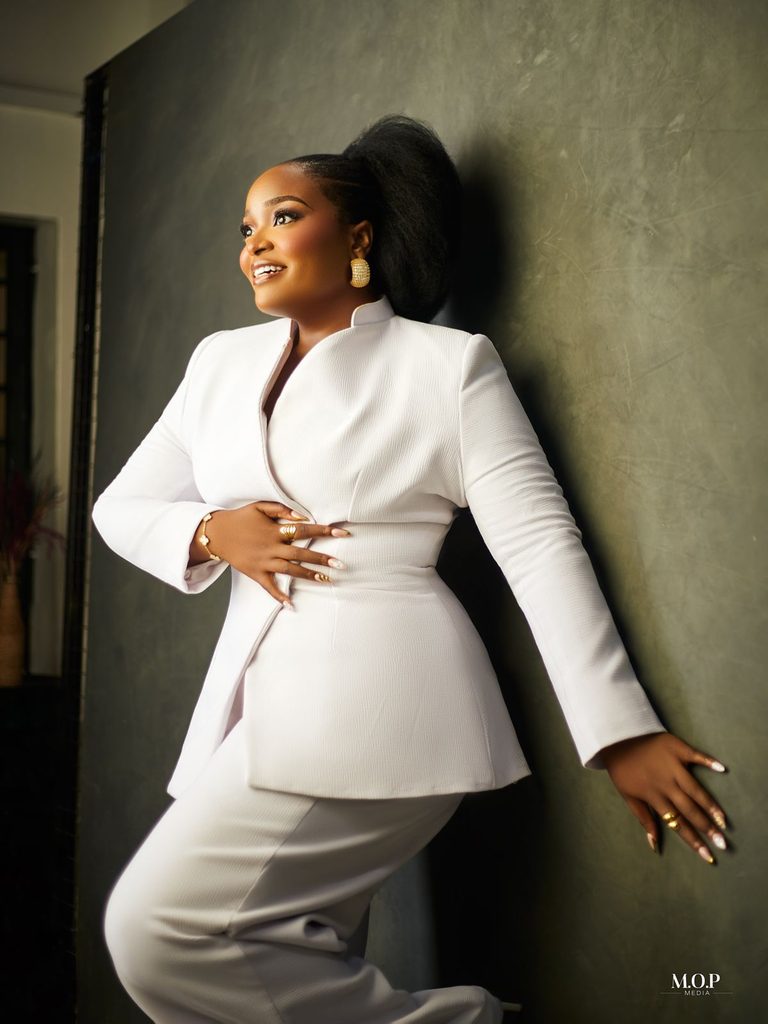
HIA: Your relationship with fashion began as a child with your fascination with Barbie dolls and eventually took you into modelling, sewing and now fashion. At what point did you realise fashion wasn’t just something you enjoyed—it was something you wanted to build?
PIS: After my Barbie doll saga in 2014, I remember my mother used to drop me off at a fashion store to learn. That was even before I began modelling.
I think I always knew that fashion was a part of me. I just didn’t know how to do it as excellently as I wanted to.
So I spent a couple of years pursuing what I would call perfection—trying to make sure that whatever I created was as close to the masterpiece in my head as possible.
I haven’t released a collection yet. I’ve sewn for a few people, I’ve experimented, I’ve learnt, and I’m still learning.
But I think that’s when I knew. 2014 was when I knew.
I knew that fashion wasn’t just something I enjoyed doing; it was something I wanted to build.
I wanted to build something that would give a lot more people room for self-expression through the pieces I created. Something that people could experience. Something that could make people feel beautiful, seen and confident.
And looking back, I think that little girl who held her first Barbie, and the girl who was learning in that fashion store in 2014, already knew.
I just needed the time, the experience and the courage to understand what she was trying to tell me.
HIA: You’ve had to learn different things along the way, sometimes starting from the beginning. How do you deal with being a beginner again when you’re already accomplished in another area?
PIS: I think learning has taught me to fall in love with the process of not knowing—to admit that I don’t know, and to embrace what it means to learn something afresh.
I’ve had to become comfortable with being a beginner again: making mistakes, failing, getting back up, and trying again.
There’s a scripture that encourages me a lot, about the righteous falling and rising again. I keep it on my chest.
So whenever I’m learning something new, I remind myself that I have to drop the crown. I have to put aside the awards and accomplishments I may have in another area and face this new thing as a learner.
And honestly, at first, I didn’t like the idea of being a beginner. I wanted to skip ahead.
But I’ve realised that learning is a stage you simply cannot skip. It’s not like a class where you can jump ahead and somehow expect to understand everything.
So now, I think I’d rather learn early than postpone the discomfort and learn later.
And there’s something beautiful about that for me.
Every time I accomplish something in a new area, I know I’m not just looking at what I’ve achieved in that moment. I’m looking at a seed.
And I know that, with time, that seed can become a big, beautiful, boisterous palm tree.
So I’m learning to respect the seed stage, too.
HIA: When you look at everything you’re building now, what kind of life are you ultimately trying to create for yourself?
PIS: When I look at everything I’m building now, I think ultimately, I’m trying to create a fulfilled life.
A life that feels full, purposeful and completely lived.
I often think about the parable of the talents in the Bible, and sometimes I joke that maybe I’m the talent they forgot to mention—the one that was given a hundred talents.
And if I have been given that much, then I want to multiply it.
I want to use everything that has been placed in my hands. I want to live a full life. A spent life. A life where I can open my eyes and see possibilities around me and know that I gave myself the courage to pursue them.
And for the young people who follow my journey, I hope they understand that they don’t have to wait for permission to pursue their dreams.
They don’t have to follow the crowd or choose one path simply because that’s what everyone else is doing.
But I also want them to understand that pursuing more than one thing doesn’t mean pursuing everything casually.
Building something takes time. We may never see the extent of the work that happens behind the scenes, so you have to be willing to roll up your sleeves, plant the seeds, water them and stay with them long enough to see what they become.
People say, “Jack of all trades, master of none.”
But I sometimes think, what if the story of my life could challenge that idea?
What if I could build a life where doing many things doesn’t mean doing them without depth, but means allowing different gifts to grow into something meaningful?
My life is still very much in motion. I’m still learning, still building, still figuring things out, and ultimately, I’m still trusting God with where He takes me.
I hope that years from now, I’ll be sitting here with more established brands, more stories and more things I’ve built, not just to say, “Look at what I achieved,” but to be able to tell someone else, “Look. It is possible.”