
Technology is transforming industries. Artificial intelligence is reshaping jobs. New careers are emerging, while others are becoming obsolete. Yet, despite these rapid changes, millions of young people are still leaving school without the skills, exposure, or guidance needed to thrive in this new reality.
For many, the challenge is not a lack of potential.
It is a lack of opportunity.
Many students complete their education without ever meeting someone working in technology. They have never attended a tech conference, interacted with a software developer, or imagined themselves building digital products that solve real problems. In underserved communities, these opportunities are even more limited, leaving many talented young people disconnected from one of the fastest-growing sectors in the world.
This growing disconnect between education and opportunity is one of the defining challenges of our time.
It is also the challenge that Oluwatosin Omotoyosi Edeboh has chosen to address.

As the Executive Director of TalentMakers Foundation, Oluwatosin is creating pathways that introduce young people to technology, innovation, and the skills they need to compete in the digital economy. Her work is built on a simple but powerful belief: every young person deserves the opportunity to succeed, regardless of where they come from or the resources available to them.
That belief has shaped every stage of her journey.
Trained as a lawyer and called to the Nigerian Bar, Oluwatosin could have followed a traditional legal career. Instead, she chose a path that combined law, governance, operations, and youth development. She became an Associate of the Institute of Chartered Secretaries and Administrators of Nigeria (ICSAN), deepening her understanding of organizational leadership and governance while continuing to build expertise in operations and business systems.
Her passion for building efficient organizations eventually led to the establishment of O’Virtual Solutions, where she supports entrepreneurs, executives, and mission-driven organizations in creating structures that improve productivity, strengthen operations, and enable sustainable growth.
While helping organizations become stronger, another realization began to emerge. Strong organizations alone are not enough. The future also depends on young people who are equipped to lead them.
That realization inspired the creation of TalentMakers Foundation, a nonprofit committed to bridging the digital divide by equipping underserved young people with digital and employability skills.
Today, the Foundation is creating opportunities that many young people would otherwise never experience. Through school outreaches, technology conferences, mentorship programmes, scholarships, and digital skills initiatives, thousands of students have been introduced to careers they never knew existed.
Under Oluwatosin’s leadership, TalentMakers Foundation has reached more than 3,500 secondary school students across 20 schools in Rivers State, exposing them to technology, innovation, and career opportunities within the digital economy.
But for Oluwatosin, the work has never been about numbers alone. Behind every student reached is someone discovering a new possibility. Someone realizing that they can become a software engineer, a product manager, a data analyst, or a technology entrepreneur. Someone beginning to believe that their future can be bigger than their present circumstances.
One of the Foundation’s flagship initiatives, TechSpark Conference, reflects this vision. The conference brings together technology professionals, innovators, educators, and students to explore emerging careers, share practical knowledge, and inspire young people to see themselves as creators rather than consumers of technology.
The Foundation has also invested in scholarship programmes that combine technical training with mentorship, career guidance, and workplace readiness, recognizing that success in today’s world requires more than technical competence. Young people also need confidence, communication skills, critical thinking, and access to mentors who can help them navigate their journey.
Beyond her work with young people, Oluwatosin continues to support founders and organizations in building the systems that make long-term impact possible. Whether she is helping an entrepreneur streamline operations or creating opportunities for students to discover careers in technology, her work is connected by one consistent theme: building capacity.
She believes that sustainable development happens when people are equipped with the right skills and organizations are strengthened with the right systems.
This philosophy has earned her recognition not only as a nonprofit leader but also as a trusted operations professional, mentor, and advocate for continuous learning.
At a time when conversations around youth unemployment continue to dominate public discourse, Oluwatosin’s work offers a practical reminder that preparing young people for the future cannot begin after graduation. It must begin much earlier, by exposing them to opportunities, equipping them with relevant skills, and helping them see possibilities beyond what they currently know.
The future of Africa will not be shaped solely by technological advancement. It will be shaped by whether young people have the opportunity to participate in that advancement.
That is why leaders like Oluwatosin matter.
They are not simply responding to today’s challenges; they are preparing young people for tomorrow’s opportunities.
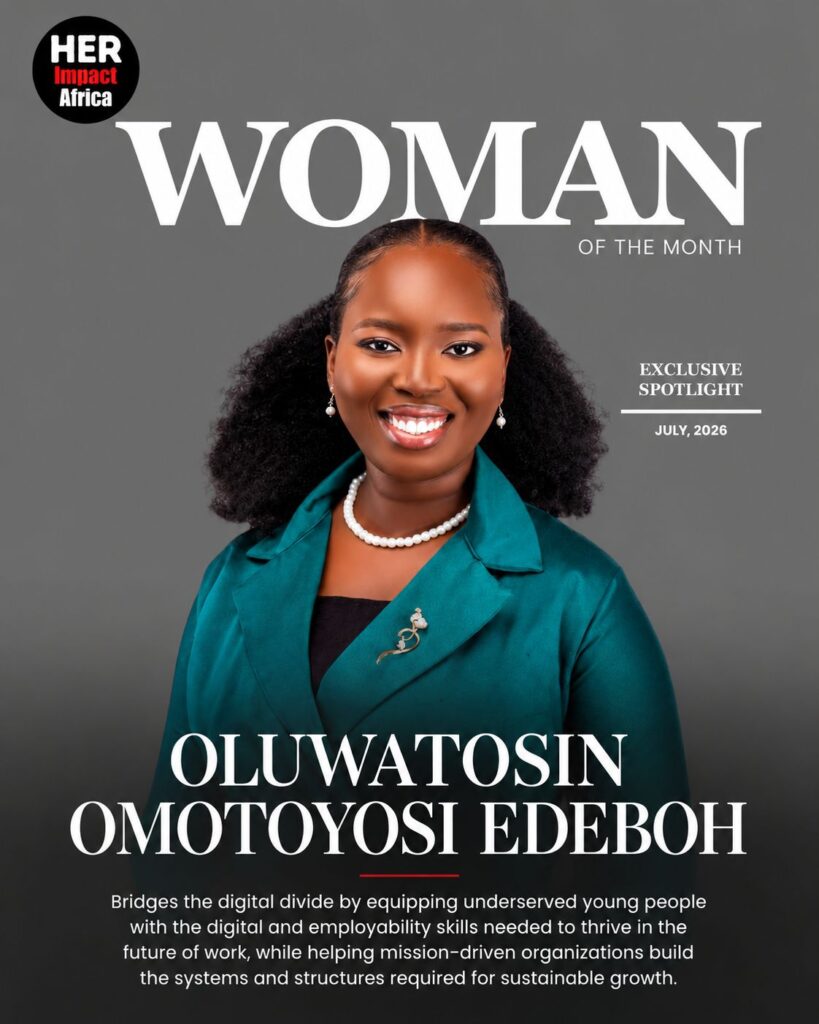
For her unwavering commitment to expanding access to digital skills, creating pathways for underserved young people, and strengthening organizations that drive meaningful change, Her Impact Africa is proud to recognize Oluwatosin Omotoyosi Edeboh as our Woman of the Month.
Her story reminds us that the most meaningful investments are not always made in buildings or technology. Sometimes, they are made in people. And when young people are given the opportunity to learn, grow, and believe in what is possible, the impact extends far beyond one individual. It transforms families, communities, and ultimately, the future of a nation.