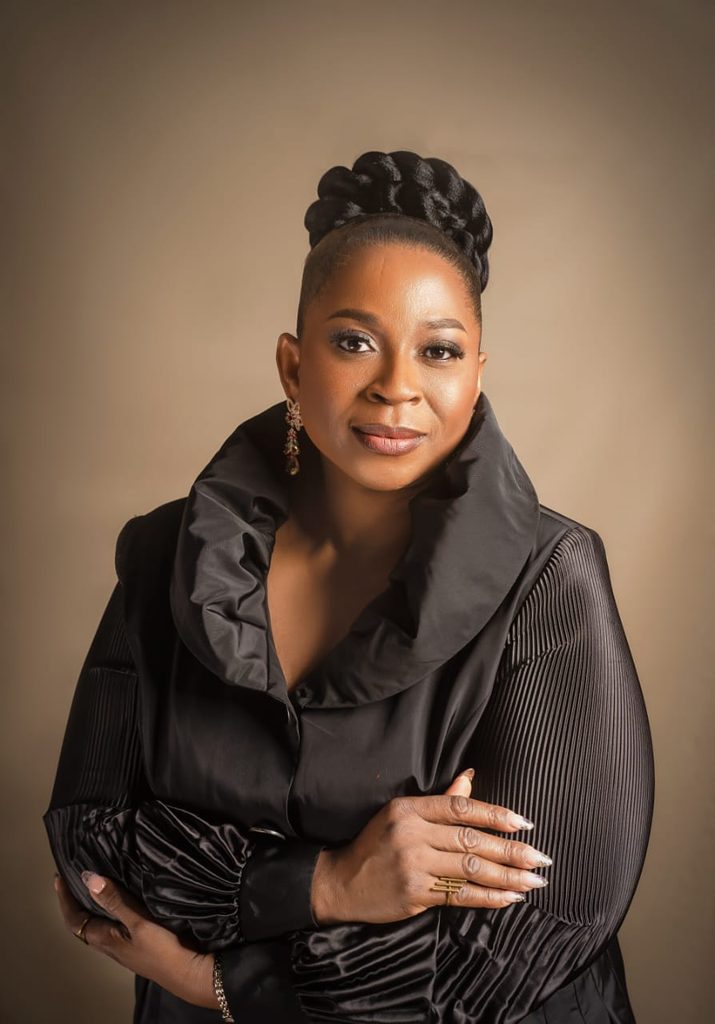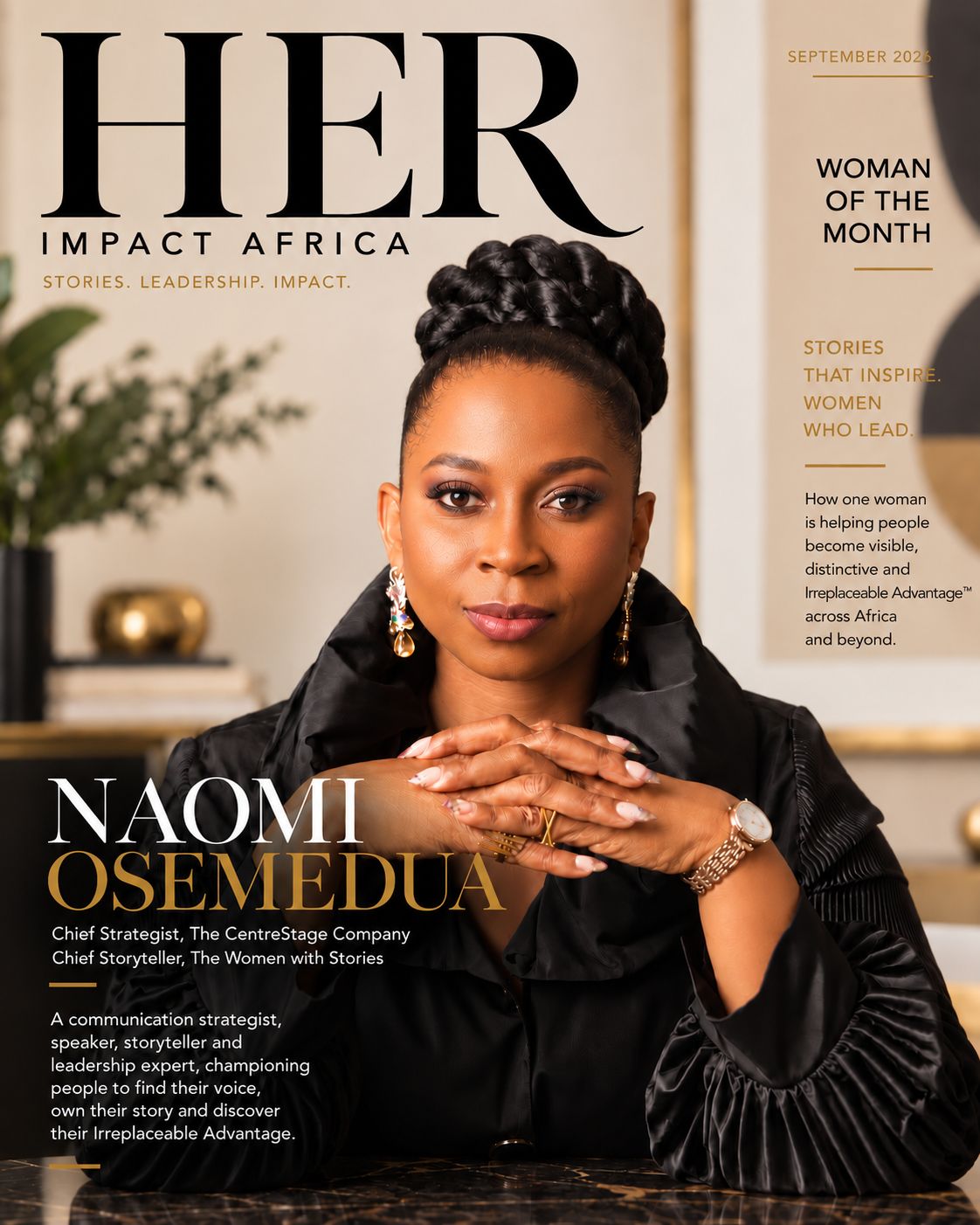

Naomi Osemedua has built a career around a simple but powerful question: What is uniquely yours to see, say, solve and shape?
A leadership thinker, storyteller, strategist and Chief Strategist at The CenterStage Company, Naomi has spent more than a decade helping leaders, entrepreneurs and organisations understand their value, strengthen their visibility and create meaningful influence.
A 2x TEDx Speaker and international voice on leadership, storytelling and human distinctiveness, she is also the creator of The Irreplaceable Advantage™ and Chief Storyteller of The Women With Stories International.
For this edition of HER IMPACT AFRICA Woman of the Month, Naomi talks about the journey behind her work, finding her voice, the changing meaning of expertise in the age of AI, and the legacy she hopes to leave behind.
HIA: Naomi, before we talk about all the amazing things you do, tell us about the woman behind the work. What has shaped you into the woman you are today?
DNO: I have always been fascinated by people.
Fun fact, as a little girl, I wanted to be a medical doctor. It was not really because I was fascinated by medicine itself. I wanted to be a doctor because I wanted to help people. I wanted to understand people, make a difference in their lives and somehow leave them better than I met them.
Life took me in a different direction. I did not become a medical doctor, but I graduated as a Human Physiologist. Looking back now, I realise that the desire underneath that childhood dream never left me. It simply found different expressions.
That curiosity about people has followed me into everything I have done, from understanding the human body, to understanding behaviour, communication, leadership, stories, identity and influence.
If curiosity shaped me, resilience has strengthened me.
I have lived many lifetimes in one lifetime. I have experienced pain. I have experienced betrayal. I have experienced seasons that could have broken me. I am still standing.
There is something powerful about being able to look at your life and say, “I have been through some things, but those things did not get the final word.”
My faith in God has also been very, very loud in my life. I genuinely believe I am not here merely to be part of the census. I am here on an assignment.
That belief changes how I approach my life, my work, my relationships and even my failures. I do not believe the gifts and talents God has given me were given accidentally. I believe they are part of what I have been entrusted with, and I have a responsibility to develop them, use them and pour them into other people.
Being a mother to two adult children and two approaching pre-teen and teenage years, has also shaped me profoundly.
Motherhood has taught me another dimension of love, responsibility, patience, sacrifice and legacy. It constantly reminds me that who we become is not only about what we accomplish, but also about what we model and what we leave behind.
I would be incomplete if I did not acknowledge the role my family has played in this journey.
I have been incredibly blessed to have a family that has supported me, believed in what I carry and given me room to pursue the things that matter to me. They have celebrated the beautiful moments, encouraged me through the difficult ones and, in many ways, made the journey lighter. I don’t take that kind of support for granted.
There are some things you build publicly that are only possible because you have people quietly standing behind you privately.
Having that kind of support has also made me more conscious of the season of life I am in. At 48, I am thinking much more intentionally about who I am becoming and what I want the years ahead to represent. This season is about becoming the best version of myself, not a perfect version, but the fullest expression of what God has placed in me.
I want the person who encounters me through my work, my speaking, my books, my ideas, my platforms, my conversations or even a brief personal encounter to experience the best version of what God has put in me.
That connects deeply to my life mission- “I want to die empty.”
I do not want to leave this world with gifts I never developed, ideas I never expressed, stories I never told, books I never wrote, rooms I never entered, people I never helped or possibilities I was too afraid to pursue.
I want to live fully, give fully and become fully.
So, when I think about the woman behind the work, I see a woman who is still curious about people, deeply rooted in faith, strengthened by resilience, shaped by motherhood and very conscious that her life is an assignment.
I am still becoming her.
HIA: Looking at your journey, from Human Physiology to Life coaching, Corporate communication, Storytelling and now leading the CentreStage Company, what do you think was really guiding you through all those different chapters?
DNO: When I look back at my journey, I don’t see a collection of disconnected careers. I see a pattern.
The titles changed, the industries changed, the rooms changed, but the question underneath my work remained remarkably consistent: How do we help people understand themselves, communicate what matters and make a meaningful difference?
Human Physiology taught me to look beneath the surface. The body is a system, and what you see on the outside is often connected to things happening underneath.
Corporate communication taught me something similar about organisations and people. What an organisation says, what it does, what people experience and what others believe about it all have to connect. That is where reputation lives.
Storytelling taught me the power of meaning. People do not simply respond to information. They respond to what that information means to them.
Leadership and strategic visibility brought those things together.
Today, I am interested in the intersection of how people think, what they see, what they communicate, how they are perceived and the kind of influence they ultimately create.
I also think there has been a divine hand in the journey. There were chapters I did not plan. There were doors I did not know I was preparing to walk through. There were experiences that only made sense much later.
Sometimes what looks like a detour is actually preparation.
That is probably one of the biggest lessons my journey has taught me. You don’t always need to understand the entire map. Sometimes you simply need to keep developing what is in your hand.
HIA: At the CentreStage Company, you work with Leaders, Entrepreneurs and Organisations around visibility, communication and reputation. What have you noticed about brilliant people that made you realise that being good at what you do is sometimes not enough?
DNO: Talent gets you noticed. Distinction gets you remembered.
I have met incredibly brilliant people who are excellent at what they do, yet their value is not fully understood by the people who need what they carry.
That is the problem we exist to solve.
We live in a world where competence is no longer enough of a differentiator. Expertise has become increasingly accessible. Information is everywhere. Technology can replicate certain skills. AI can produce remarkably sophisticated outputs.
So the question is changing.
It is no longer simply, “What do you know?”
It is, “What do you see that others don’t see? How do you interpret what you see? What patterns can you recognise? What judgment can you bring to a situation? What can you create from your particular combination of experience, values and perspective?”
That is where I think many brilliant people have a blind spot.
They know their expertise so well that they assume everyone can see what they see.
They cannot.
Your perspective may feel ordinary to you precisely because you have lived with it for so long. The way you connect ideas, solve problems, read people, anticipate risks or see opportunities may be completely natural to you.
Yet that can be the very thing that makes you valuable.
At the CenteStage Company, our work is increasingly about helping people recognise that invisible value, articulate it and translate it into influence.
Visibility without substance is noise. Substance without visibility is often overlooked.
The real opportunity is to bring the two together.
HIA: The Irreplaceable Advantage™ is such an interesting idea. What was happening in your own journey when you began thinking about this question: What is uniquely mine to see, say, solve and shape?
DNO: The question actually emerged from a deeper concern I had been carrying for a while: What happens to human value when almost everything around us can be replicated?
I had spent years helping people become more visible, communicate better and build stronger reputations. Yet I began to realise that visibility alone was not the deepest question.
A person can become very visible and still be replaceable.
That distinction became important to me.
I started thinking about my own journey too. What was it about my particular combination of experiences that had brought me to the work I was doing?
It wasn’t one qualification. It wasn’t one job. It wasn’t even one skill. It was the combination.
Human Physiology. Communication. Storytelling. Leadership. Strategy. Years of working with people. Years of observing organisations. Years of failure and reinvention. My faith. My cultural context. The rooms I have entered. The people I have encountered. The questions I have learned to ask.
Somewhere in that combination was something that could not simply be downloaded from a course or copied from a profile.
That led me to the question: What is uniquely mine to see, say, solve and shape?
The Irreplaceable Advantage™ emerged from that question.
It is not about trying to become someone nobody else can replace. It is about understanding the particular human contribution that emerges from your lived experience, perspective, values, patterns of thinking, judgment and capabilities, then learning how to make that contribution visible and valuable.
HIA: And when you say “Irreplaceable,” what does that actually mean? Especially now, when AI is changing the way we work and making it possible to replicate things that once required years of expertise.
DNO: When I say “Irreplaceable,” I am not talking about being indispensable.
There is a very important distinction.
The Irreplaceable Advantage™ is not about superiority. It is not about believing nobody else can do what you do. It is not about building a personality cult around yourself. It is not anti-technology, and it is certainly not simply another personal branding exercise.
It is about understanding human distinctiveness.
The framework is informed by ideas from behavioural science, cognitive science, expertise and pattern recognition, identity and organisational thinking. It looks at how people develop ways of seeing, interpreting, deciding and responding over time.
We accumulate what I call invisible assets.
Our lived experiences. Our failures. Our relationships. Our cultural knowledge. Our values. Our intuition. Our questions. Our resilience. The patterns we have learned to recognise. The judgment we have developed through experience.
Most people don’t put a value on these things because there is no certificate for them.
AI makes this conversation even more urgent.
If technology can increasingly reproduce information, generate content, analyse data and perform certain technical tasks, then human beings have to become much more conscious of the value that cannot be reduced to output alone.
The question becomes: What do you bring to the table that comes from the way you see, think, interpret, connect and create?
That is what I mean by The Irreplaceable Advantage™.
The goal is not to make yourself impossible to replace.
The goal is to know what is uniquely yours to contribute, and to make that contribution matter.
HIA: One thing that stands out in your work is the emphasis on helping people recognise what is already within them. Why do you think it can be so difficult for people, especially high-achieving people, to recognise what makes them different?
DNO: Sometimes the things that make us exceptional are the things we have become too familiar with to notice.
High achievers often have an interesting challenge. They are so focused on the next achievement that they rarely stop to examine the architecture of what has already made them successful.
They know what they have achieved, but they may not know why they are uniquely able to achieve it.
There is also the challenge of proximity.
You are often the least objective person when it comes to your own brilliance because you experience your thinking every day. What feels obvious to you may be extraordinary to somebody else.
A strategist may think, “I just connected the dots.”
A storyteller may think, “I just told the story.”
A leader may think, “I just saw what needed to be done.”
Yet those seemingly ordinary actions can reveal years of accumulated judgment and pattern recognition.
That is why I am interested in helping people slow down enough to see themselves.
The work is not about manufacturing uniqueness. It is about recognition.
What do you naturally notice?
What questions do people come to you with?
What problems do you see before others do?
What do people consistently trust your judgment on?
What have your experiences taught you that you may be taking for granted?
Those questions can reveal an enormous amount.
Sometimes the greatest discovery is realising that the thing you have been calling “just me” is actually part of your advantage.
HIA: Storytelling has become a huge part of your work, including through The Women With Stories International. Why do you think women can be so accomplished and still struggle to tell their own stories with confidence?
DNO: This is a big one but I have to say it…Many women have been taught to be accomplished before they are taught to be visible.
We are often taught to work hard, deliver, serve, support, achieve and make sure everyone else is okay. We become very good at producing results, but not necessarily at documenting or communicating the value behind those results.
There is also a cultural conditioning around humility.
A woman can tell you everything she has done for everybody else, but ask her to tell you what she has built, what she has overcome, what she has changed or what she knows, and suddenly she becomes uncomfortable.
I have seen this repeatedly through the work we do at The Women With Stories International.
Women have extraordinary stories. The challenge is that many have never been taught to see their own lives as stories worth telling.
I think storytelling is not simply a communication skill. It is an act of recognition.
When you tell your story, you are saying, “My experience has meaning. What I have learned matters. My voice has something to contribute.”
That is why what we do at the Women With Stories is so important to me.
I don’t want women to simply be statistics, photographs or names on a programme list. I want women to understand that their lived experiences contain knowledge, wisdom and possibility for somebody else.
Your story is not only about where you have been.
It can become a bridge for someone who is still trying to find their way.
At the Women with Stories- our belief is simple- YOUR STORY IS A GIFT!
HIA: You have spoken on stages across four continents and at TEDx Providence. What has stepping into those international spaces taught you about finding your voice, and about being an African woman in rooms that may not always see Africa beyond the usual narratives?
DNO: I learned very early that my voice does not become more valuable because I am in an international room.
I simply have to know what I came to contribute.
There was a time when international visibility could feel like something you had to earn permission to access. I don’t think that way anymore.
My philosophy is very simple: Why be local… When you can be Global?
I am proudly African, deeply Nigerian, but I don’t believe my ideas should be confined by geography.
Speaking across four continents has taught me that people everywhere are wrestling with many of the same questions: identity, leadership, belonging, influence, purpose, family, ambition, change and legacy.
The context may be different, but the human questions are remarkably universal.
Being an African woman in those spaces has also made me more conscious of representation. I don’t want to enter international rooms simply to prove that an African woman can be there.
I want to bring something valuable into the room.
That distinction matters to me.
I don’t want Africa to be represented only through stories of hardship, poverty or limitation.
There are powerful intellectual, creative and strategic ideas emerging from this continent, and I want to be part of that conversation.
My voice has travelled because I have something to say.
That is also why I tell people not to shrink their ambition to fit the size of the room they currently occupy.
Sometimes the room is simply too small for what you have been carrying.
HIA: After more than a decade of doing this work, what is one belief about leadership, visibility or influence that you have completely changed your mind about?
DNO: I used to think visibility was largely about being seen.
I now believe visibility is about being understood.
There is a huge difference.
You can be everywhere and still be misunderstood. You can have thousands of followers and still have very little influence. You can have an impressive title and still not be clear about the value you bring.
Real influence requires meaning.
People need to understand what you stand for, what you see, what you know, what you believe and why your contribution matters.
I have also changed my mind about leadership.
I used to think leadership was primarily about what you could get people to do.
I now think it is much more about what becomes possible because you are in the room.
That is a very different measure.
The strongest leaders do not simply occupy space. They change the quality of thinking around them.
They create clarity. They see possibilities. They ask better questions. They make decisions. They develop people. They create systems that continue to work beyond them.
That is the kind of influence I am increasingly interested in.
Not fame.
Not noise.
Not simply being known.
I want influence that makes this world a better place for us all because a better me and a better you…becomes a better world.
HIA: You have said that your life mission is to “die empty.” I love how simple but profound that is. What does “die empty” mean to Naomi, and what are you determined to pour into the world before your time here is done?
DNO: To die empty means to leave nothing essential undone.
It means I want to give this life everything I was given.
I want to develop every gift God has entrusted to me. I want to tell the stories I have been given to tell. I want to write the books. Stand on the stages. Build the institutions. Mentor the people. Have the difficult conversations. Enter the rooms. Create the ideas. Raise people who are stronger because our paths crossed.
I don’t want to arrive at the end of my life carrying unopened gifts.
There is a scripture that says, “For we are His workmanship, created in Christ Jesus for good works.” That has always resonated deeply with me. I believe there are things I have been created to do, and I take that responsibility seriously.
Dying empty does not mean doing everything.
It means doing the things that are mine to do.
That distinction is important because comparison can make you spend your life building someone else’s assignment.
I am increasingly interested in legacy, not simply achievement.
What remains when the applause stops?
Who is better because I was here?
What ideas continue travelling after I am gone?
What systems did I build that outlived my presence?
What courage did I awaken in somebody else?
At 48, I think about those questions much more deliberately.
I want to become the best version of myself, not because I am trying to prove something, but because I understand that time is stewardship.
I want to live fully.
I want to love fully.
I want to serve fully.
I want to create fully.
Then, when my assignment is complete, I just don’t want to be able to say, “I gave it everything I had.”
…I also want to hear “well done, good and faithful servant, enter into your rest.”
That, to me, is what it means to die empty.
HIA: You have built a career around helping people become more visible, relevant and distinctive. Looking ahead, what do you believe the next chapter of your work is really about, and what change do you want to be known for creating?
DNO: I think the next chapter is about moving from visibility to significance.
For many years, my work has been about helping people and organisations communicate, become visible, build credibility and influence the way they are perceived.
Those things still matter.
I am now more interested in what happens underneath them.
What is the thinking that makes someone genuinely distinctive?
What happens when people understand their own intellectual and human assets?
How do we prepare leaders for a world where technology can increasingly replicate expertise, but cannot replicate a person’s entire lived perspective?
How do we help women stop waiting for permission to articulate what they know?
How do we build leaders who are not simply successful in their moment, but whose thinking and contribution remain valuable over time?
That is where The Irreplaceable Advantage™ comes in.
I see it becoming much bigger than a programme. I see it as a body of thought, a leadership philosophy and a practical framework for understanding human distinctiveness in a rapidly changing world.
Ultimately, I want to be known for helping people see what they could not see about themselves, and then helping them turn that insight into influence and impact.
I want to leave people clearer, braver and more useful to the world than I found them.
That has probably been the thread running through my entire life.
The little girl who wanted to become a doctor because she wanted to help people is still here.
The profession changed. The platforms changed. The rooms became bigger. The assignment did not. I still want to help people.
I simply understand now that sometimes the most powerful way to do that is to help them discover who they were always capable of becoming.